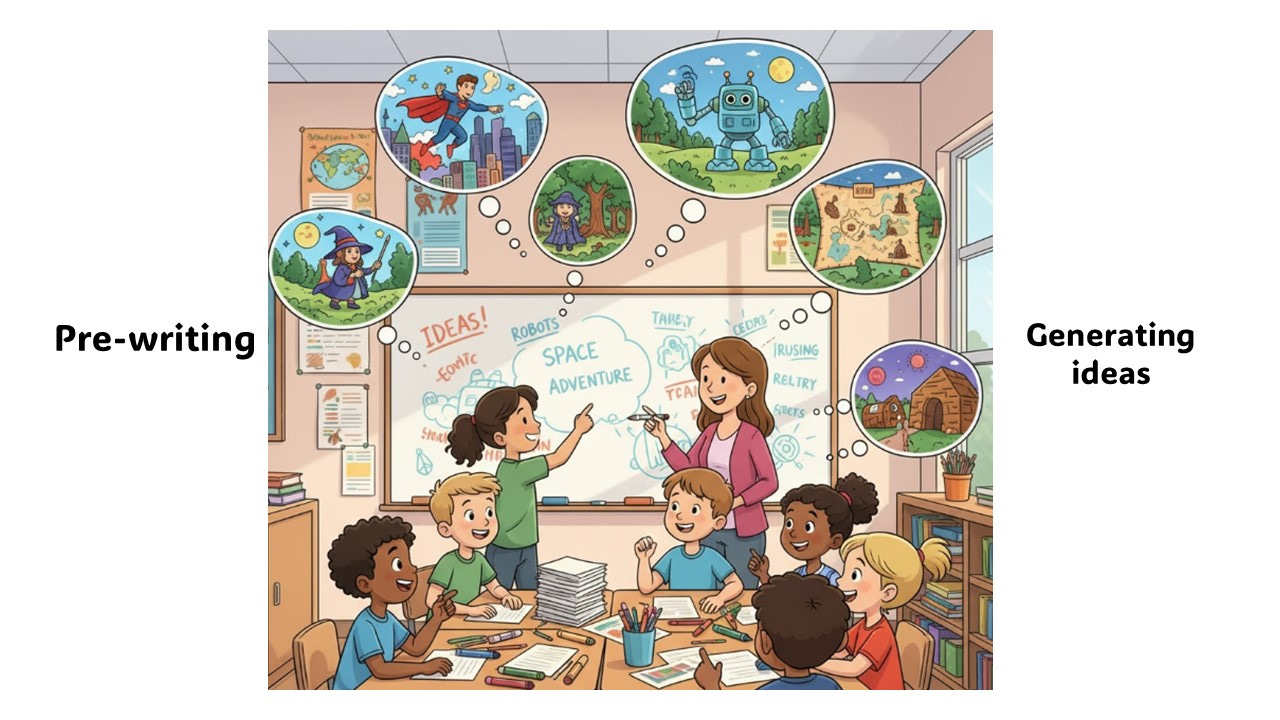
The pre-pre-writing strategies described in the last chapter involved generating possible writing topics. Pre-writing strategies are used to help students generate ideas and organize ideas based on the writing topic (Prichard & Honeycutt, 2006). For expository writing and scientific writing, pre-writing strategies also include ideas for gathering data (see Chapters 22, 23, and 24). A good pre-writing strategy will make the drafting and revision processes much more effective.
Pre-Writing Strategies
Described here are seven pre-writing strategies. There is nothing overly complex about these. Keep it that way. And like all educational strategies, always adopt and adapt to meet the needs of your students.
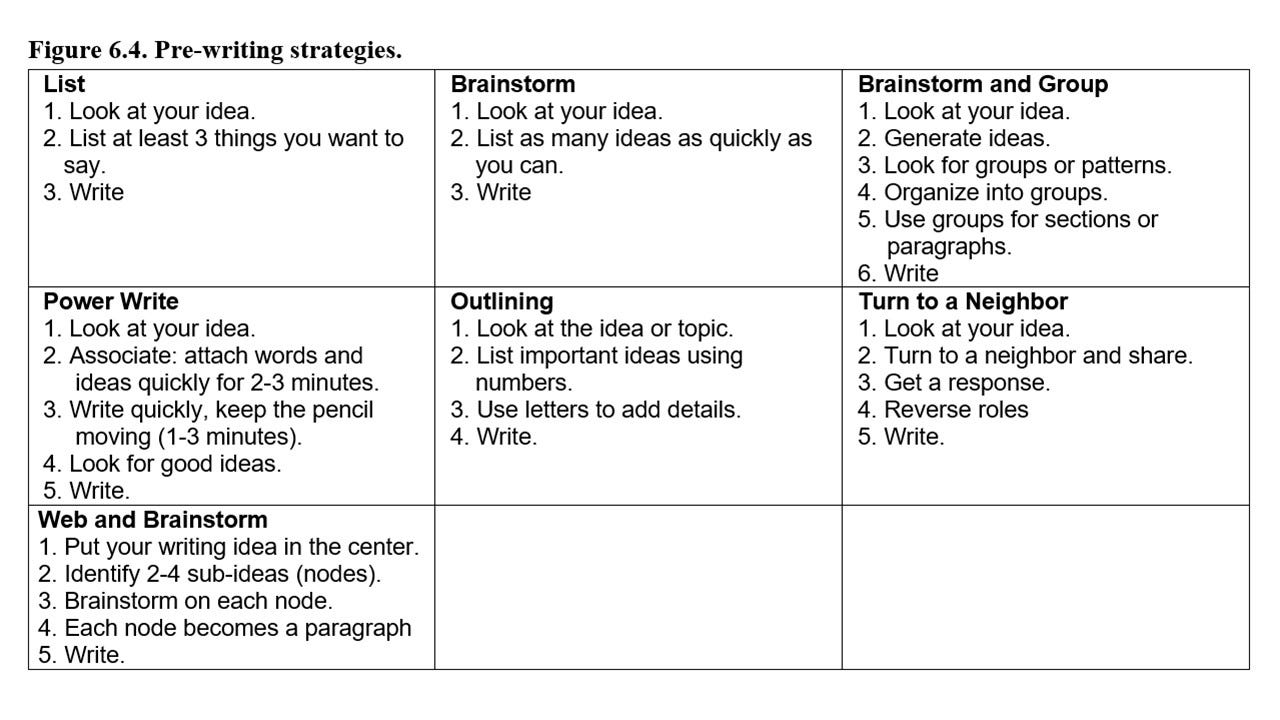
List 3. Before writing, students list three things they want to say about their idea. When they have at least three, they can start writing.
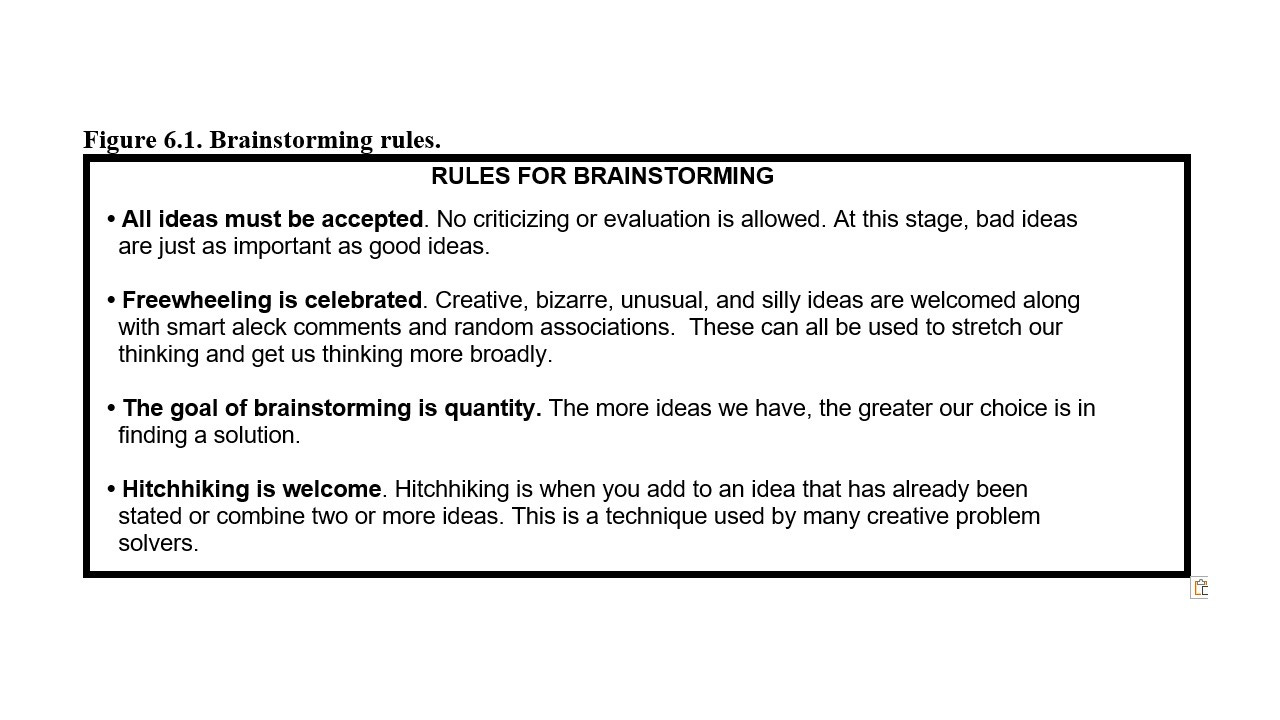
Brainstorm. Starting with the writing idea, students generate as many related ideas as quickly as they can. The goal in brainstorming is to generate a large quantity of ideas without evaluating any of them. A word or two should be used to hold each idea. You cannot assume that students at any level know how to brainstorm. That means you have to teach and demonstrate the process. The rules for brainstorming are listed in Figure 6.1. Put these rules in poster form to assist your initial brainstorming instruction, then use them for quick review when needed.
Brainstorm and group. The brainstorm and group strategy simply adds inductive analysis at the end of the brainstorming session. Here, related ideas are put into groups. These groups are then used as either paragraphs or sections in the paper.
Power write. The power write was described in the last chapter as a way of finding writing topics. It’s also a good pre-writing strategy. With these pre-writing strategies, students write continuously for 1 to 3 minutes. This is different from the free write, where students generally write at a slower pace for 5 to 10 minutes. With the power write, students must keep their pencil moving continuously. If nothing comes to mind, they write, “pencil, pencil, pencil” until something pops into their head. The goal here is to get around the logical mind that’s editing the thoughts and to get to the unconscious mind, where the good ideas are percolating.
Outlining. Outlining works best for expository text. The important thing here is to keep it simple. Use numbers to list the ideas and letters to identify supporting ideas or to add details to an idea. Do NOT insist on official outlining form.
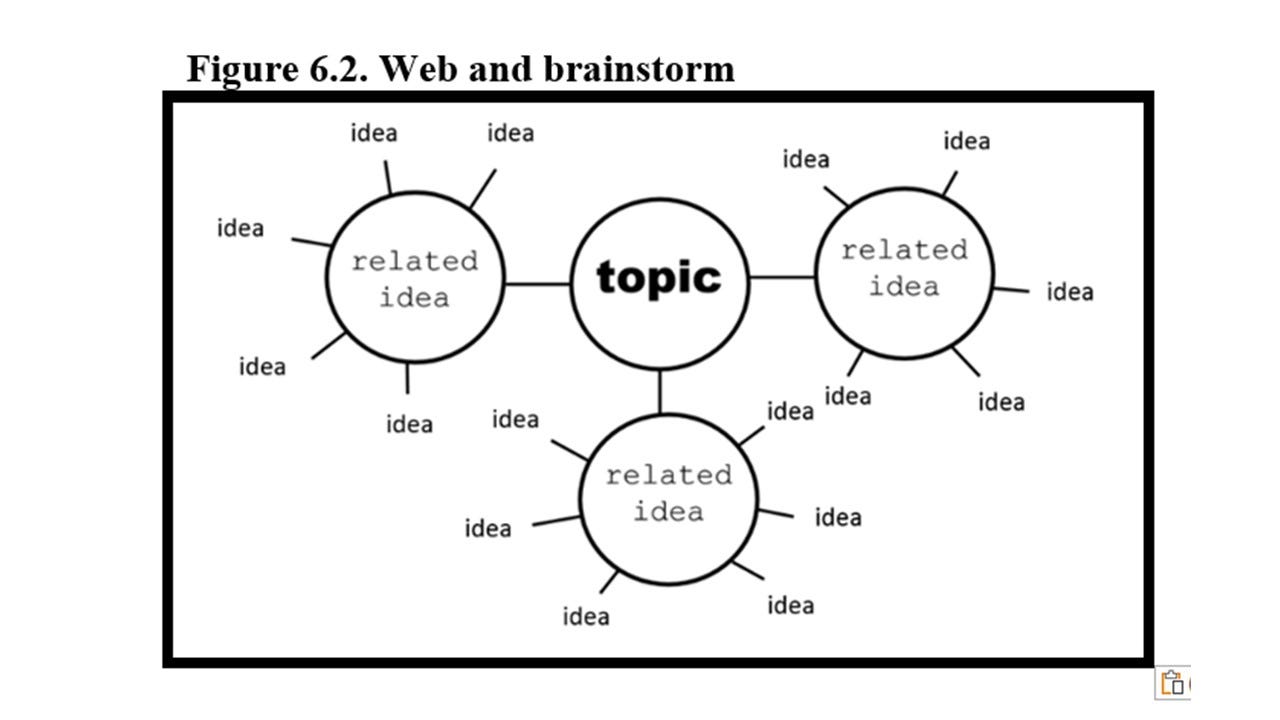
Web and brainstorm. The web and brainstorming strategy provides the same type of structure as an outline; however, it’s more spatial and more visually stimulating for some (see Figure 6.2). Here, the writing topic or idea is used as a central bubble. Two to four related ideas are used as the nodes. Students then brainstorm to generate ideas related to each node.
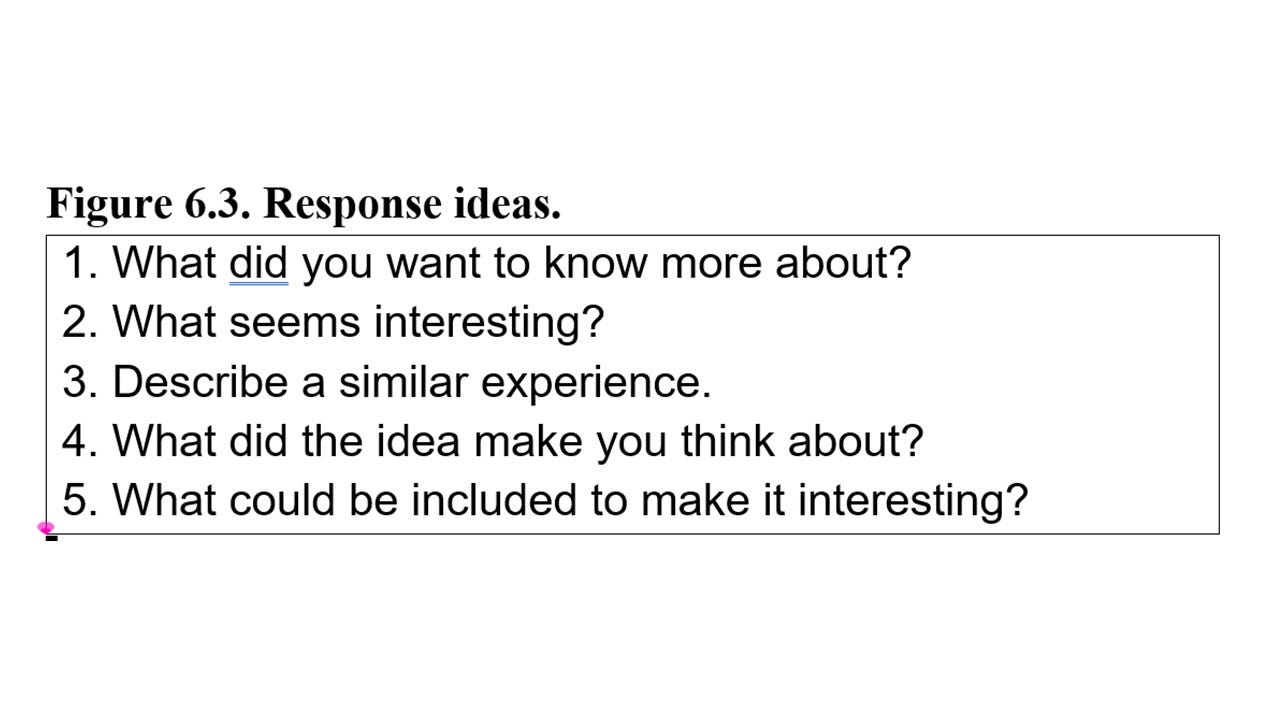
Turn to a neighbor. Here, students turn to a neighbor and simply describe their writing idea. The neighbor then responds to the idea before the roles are reversed. Some response ideas should be posted to provide students with some structure initially (see Figure 6.3).
Teaching Pre-Writing Strategies
Pre-writing strategies should be taught explicitly using the elements of effective skills instruction described in Chapter 15. For this you will need to break these strategies down into steps (see Figure 6.4). Put the strategies and steps in poster form for the initial teaching episode and keep them posted as a guide and reminder. Before writing, remind students to use a pre-writing strategy. But not all strategies work for all students, thus, you should encourage them to use the strategy that works best for them. Also, these are not algorithms to be followed with fidelity. They are heuristics. Always encourage students to adopt and adapt.